
VIbratory Bowl Feeder vs Step Feeder
Intro
When designing an automated assembly, inspection or packaging line, choosing the right parts feeding system directly impacts yield, part quality and uptime. Vibratory bowl feeder vs step feeder is a frequent question for automation engineers. Two mainstream orienting feeders are widely adopted across the automation industry: vibratory bowl feeders and step feeders.Many machine builders struggle to tell which one fits their workpiece. This article compares their working principle, pros & cons, feeding performance, noise level, part compatibility and total cost, to help you make the correct selection.
What is a Vibratory Bowl Feeder?
A vibratory bowl feeder relies on electromagnetic vibration to drive the circular bowl. Bulk components climb along the spiral track inside the bowl. Special tooling on the track filters out incorrectly oriented parts and only lets properly positioned parts pass to the downstream track.
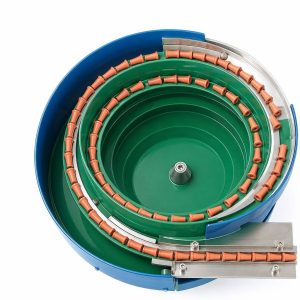
✅ Advantages
- High feeding rate: Typically 60–120 pieces per minute, suitable for high-volume production
- Mature technology, wide supply chain, lower initial investment
- Works well for rigid, standard hardware parts such as screws, pins, springs and stamped metal parts
- Compact footprint for many standard models
❌ Disadvantages
- Continuous vibration may scratch, chip or wear plated, painted, thin-wall or cosmetic-critical parts
- Higher running noise
- Magnetic components can be disturbed by the electromagnetic drive
- Tooling rework is usually required when switching to a new part, which increases changeover time and cost
What is a Step Feeder?
A step feeder is a low-vibration, mechanical orienting feeder. It uses a set of reciprocating lifting steps driven by cam or pneumatic actuators. The steps rise to pick up parts from the hopper. Correctly seated parts are carried upward, while misaligned parts slide back down into the storage hopper by gravity. There is no continuous high-frequency vibration during feeding.
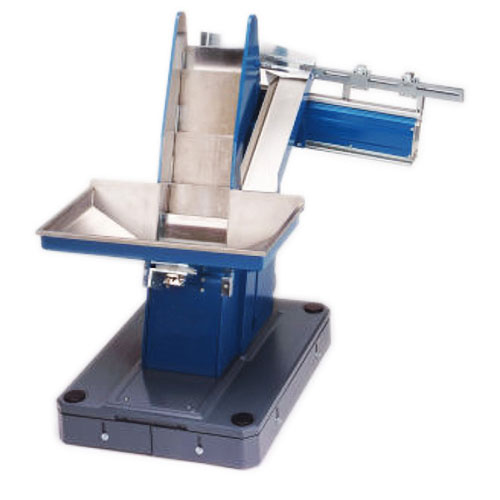
✅ Advantages
- Gentle feeding action, minimal part marking or scratching. Ideal for delicate plastic parts, electroplated components, thin shims and polished cosmetic parts
- Much quieter operation, better for noise-controlled workshops
- No electromagnetic interference, safe for magnetic and electronic components
- Lower wear on workpieces, reduces reject rate caused by surface damage
❌ Disadvantages
- Feeding speed is generally lower, around 20–80 pieces per minute
- Higher purchase cost than a standard vibratory bowl feeder
- Larger overall size for some models with large hopper capacity
Side‑by‑Side: Vibratory Bowl vs Step Feeder Comparison
| Item | Vibratory Bowl Feeder | Step Feeder |
|---|---|---|
| Driving method | Electromagnetic vibration | Mechanical lifting steps (cam / air cylinder) |
| Vibration level | Continuous high-frequency vibration | Intermittent movement, no persistent vibration |
| Feeding speed | High: 60–120 pcs/min | Moderate: 20–80 pcs/min |
| Part surface risk | Medium ~ high (scratch risk) | Very low |
| Noise | Louder | Quiet |
| Best for | Hard, robust parts, high throughput, low budget | Delicate, plated, polished, thin & cosmetic parts |
| Initial cost | Lower | Higher |
| Magnetic parts | Not recommended | Suitable |
How to Choose: Vibratory Bowl Feeder vs Step Feeder
Choose a vibratory bowl feeder if:
- You have high cycle rate requirements
- Your parts are hard, durable and not sensitive to surface marks
- You are working on a tight equipment budget
- Parts are simple standard fasteners or thick metal components
Choose a step feeder if:
- Surface finish is critical and scratches lead to scrap
- Parts are soft plastic, thin, plated, coated or fragile
- Your factory has strict noise limits
- You feed magnets or electronic components sensitive to magnetic fields
Final Verdict
Neither feeder is universally better. The vibratory bowl feeder remains the cost-effective workhorse for high-speed feeding of tough parts. The step feeder is the premium gentle-feeding solution designed to protect delicate workpieces.
For mixed production lines, some integrators combine both types: vibratory bowls for bulk robust parts and step feeders for cosmetic-sensitive components.
FAQ
Q: Can a step feeder run as fast as a vibratory bowl feeder?
A: In most cases no. Step feeders rely on gravity re‑orientation, which sets a natural upper limit on speed. If you need 120+ ppm, vibratory bowl is usually the first option.
Q: Is it possible to modify a vibratory bowl to avoid scratching parts?
A: You can add polyurethane lining, reduce amplitude and slow down vibration. But for high‑gloss plated parts, scratches are still hard to eliminate completely. Step feeder is more reliable for cosmetic parts.
Q: Which one is easier to retool for new products?
A: It depends on design. Custom vibratory bowls often need full track rework. Modern modular step feeders sometimes only need step inserts changed, which saves changeover time.